
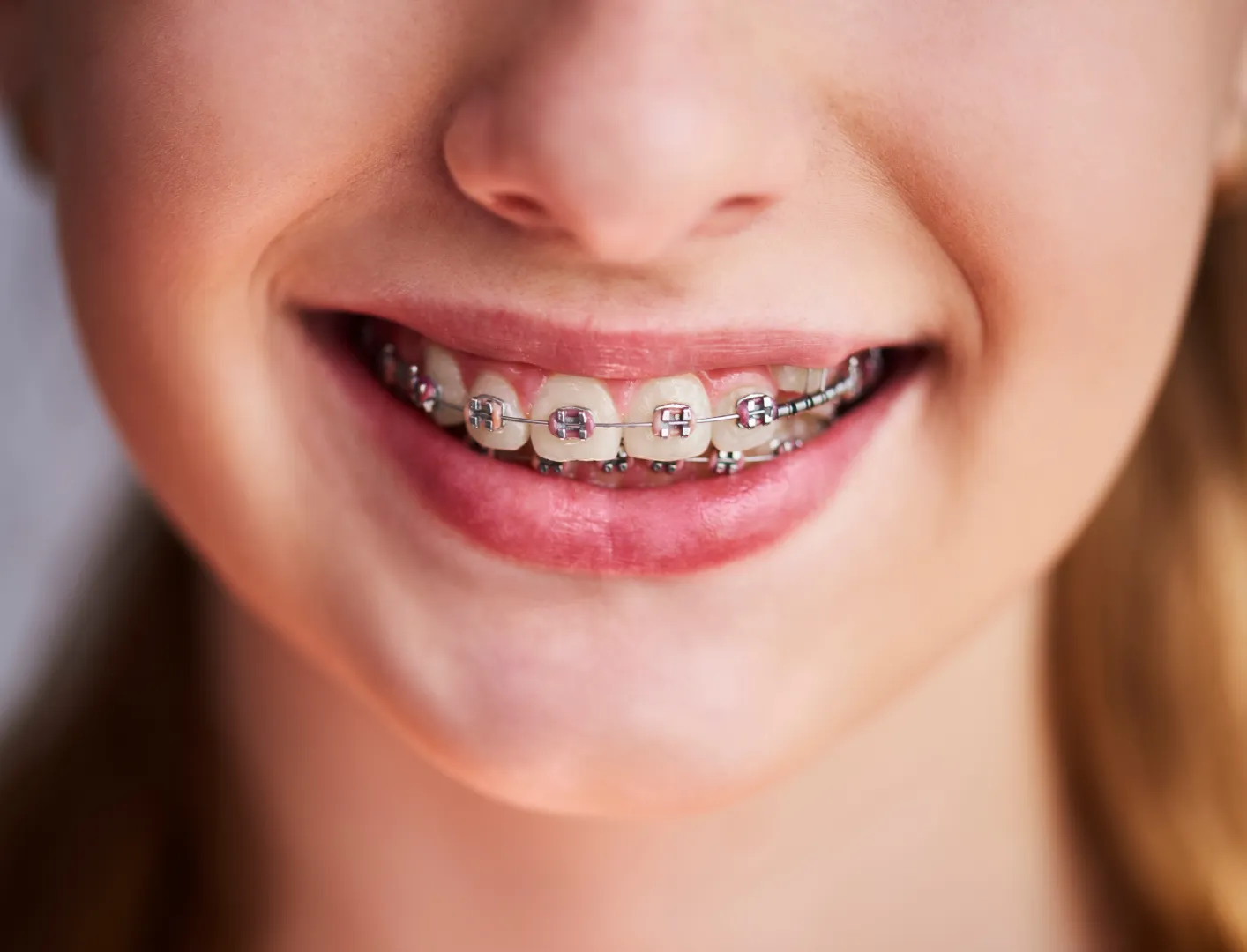
If you are looking into orthodontic treatment and trying to decide between braces and Invisalign, you are not alone. It is one of the most common questions patients bring to their first consultation, and it is also one of the most misunderstood. Most of what you read online oversimplifies the decision by framing it as braces for serious cases and Invisalign for mild ones. The reality is more nuanced than that.
At Gardner & La Rochelle Orthodontics, our team treats patients with both options every day. We are a top 1% Diamond Plus Invisalign provider and one of the few practices in Richmond offering LightForce 3D-printed braces alongside traditional metal and ceramic options. That means we have no financial incentive to steer you toward one or the other. What follows is how we actually think through this decision with our patients.
The Core Difference
Both braces and Invisalign move teeth by applying controlled pressure over time. The clinical outcomes for a wide range of cases, including crowded teeth, gaps, overbites, underbites, crossbites, and open bites, are comparable between the two when treatment is managed by an experienced orthodontist.
The difference is in how that pressure gets applied. Braces use brackets bonded to each tooth connected by an archwire, which the orthodontist adjusts at regular appointments. Invisalign uses a series of custom-fit plastic aligners, each one moving your teeth incrementally before you switch to the next.
Neither system is universally better. What changes is which one is better for your specific bite, your treatment goals, and your daily life.
When Braces Are the Stronger Choice
Braces remain the most versatile orthodontic tool available, particularly for cases that require precise three-dimensional tooth control. If your case involves any of the following, braces may produce a faster or more predictable result:
Significant bite correction. Overbites, underbites, and crossbites with a skeletal component often respond better to braces, especially when combined with rubber band elastics or other appliances that work alongside the brackets and wire.
Severe crowding. When teeth are significantly overlapped or rotated, braces give the orthodontist more control over the direction and extent of movement.
Younger patients. For children and younger teens whose bites are still developing, braces allow for more precise intervention during critical growth windows.
Compliance concerns. Invisalign only works when aligners are worn 20 to 22 hours per day. Braces are fixed, so there is nothing to forget or leave on the bathroom counter. For patients who are honest with themselves about their compliance habits, this is a real practical consideration.
Complex cases overall. The more moving parts a case involves, the more control the orthodontist needs. Braces provide that control more reliably across a broader range of complexity.
Within the category of braces, the type matters too. At Gardner & La Rochelle Orthodontics we offer:
- Traditional metal braces, which are the most proven and cost-effective option
- Ceramic braces, which use tooth-colored brackets for a lower-profile appearance while delivering the same clinical precision as metal
- LightForce 3D-printed braces, where every bracket is custom-fabricated to match the exact shape of each tooth, allowing for more efficient movement and often a shorter overall treatment timeline
When Invisalign Is the Stronger Choice
Invisalign has expanded significantly in what it can treat. Complex cases that would have required braces a decade ago are now routinely handled with clear aligners, particularly in the hands of an experienced provider.
Invisalign tends to be the better fit when:
Appearance is a primary concern. Aligners are nearly invisible in everyday life. For adults in professional settings, for teens who are image-conscious, and for anyone who would rather not have metal brackets visible in photos and conversations, Invisalign offers a level of discretion that braces simply cannot match.
Lifestyle flexibility matters. Because aligners come out for meals, there are no food restrictions with Invisalign. You eat what you want, brush and floss normally, and put them back in. Patients with active social lives, sports commitments, or who play wind instruments often find this flexibility worth the tradeoff.
The patient is reliable about wear time. For patients who know they will keep aligners in as directed, compliance is not a concern and Invisalign delivers results that are clinically equivalent to braces across most cases.
Mild to moderate crowding, spacing, or bite issues. These cases are where Invisalign is most efficient. Straightforward alignment cases often move faster with aligners than with braces.
Adult patients managing post-braces relapse. Adults who had orthodontic treatment years ago and have experienced some shifting over time are often ideal Invisalign candidates. The cases are typically moderate, and the patient is usually motivated and compliant.
The Attachments Question
One thing patients are often surprised by is that most Invisalign cases today involve attachments. These are small tooth-colored composite bumps bonded to specific teeth that give the aligners additional grip and leverage for more precise movement.
Attachments make Invisalign capable of handling a much wider range of tooth movements than the aligner alone. They are matched to your tooth color and are not obvious to others. If your treatment plan includes attachments, you will still need to remove your aligners before eating, and certain hard or sticky foods should be avoided even with aligners out to protect the bonded composite.
Not every patient needs attachments. Your treatment plan will spell out exactly what is involved in your case.
What About Cost?
In many practices, Invisalign carries a price premium over braces. At Gardner & La Rochelle Orthodontics, our treatment fees are based on case complexity rather than treatment type. A straightforward Invisalign case and a straightforward braces case are priced comparably. A complex case requiring significant bite correction will cost more regardless of which system is used.
All treatment at our practice is all-inclusive. Your fee covers your full treatment, all adjustment visits, any refinements during treatment, and your final retainers. There are no per-visit charges or surprise add-ons.
Most dental insurance plans that include orthodontic benefits will apply them equally to braces and Invisalign. Our team verifies your benefits before treatment begins and will give you a clear breakdown of out-of-pocket cost at your consultation.
The Honest Answer
The question "braces or Invisalign?" does not have a universal correct answer. The right choice comes from an accurate assessment of your bite, an honest conversation about your lifestyle and preferences, and a treatment plan built around both.
What we can tell you is that at Gardner & La Rochelle Orthodontics, you will not be pushed toward one option for the wrong reasons. We have the tools, the training, and the experience with both systems to give you a genuine recommendation. Dr. Gardner holds Diamond Plus Invisalign status and has treated thousands of Invisalign cases. Our team offers LightForce alongside traditional metal and ceramic braces for patients where braces are the right call.
The best starting point is a free consultation. Bring your questions, and we will give you a straight answer about which direction makes the most sense for your specific situation.
Schedule a free consultation at our Gaskins Road or Willow Lawn office.


